
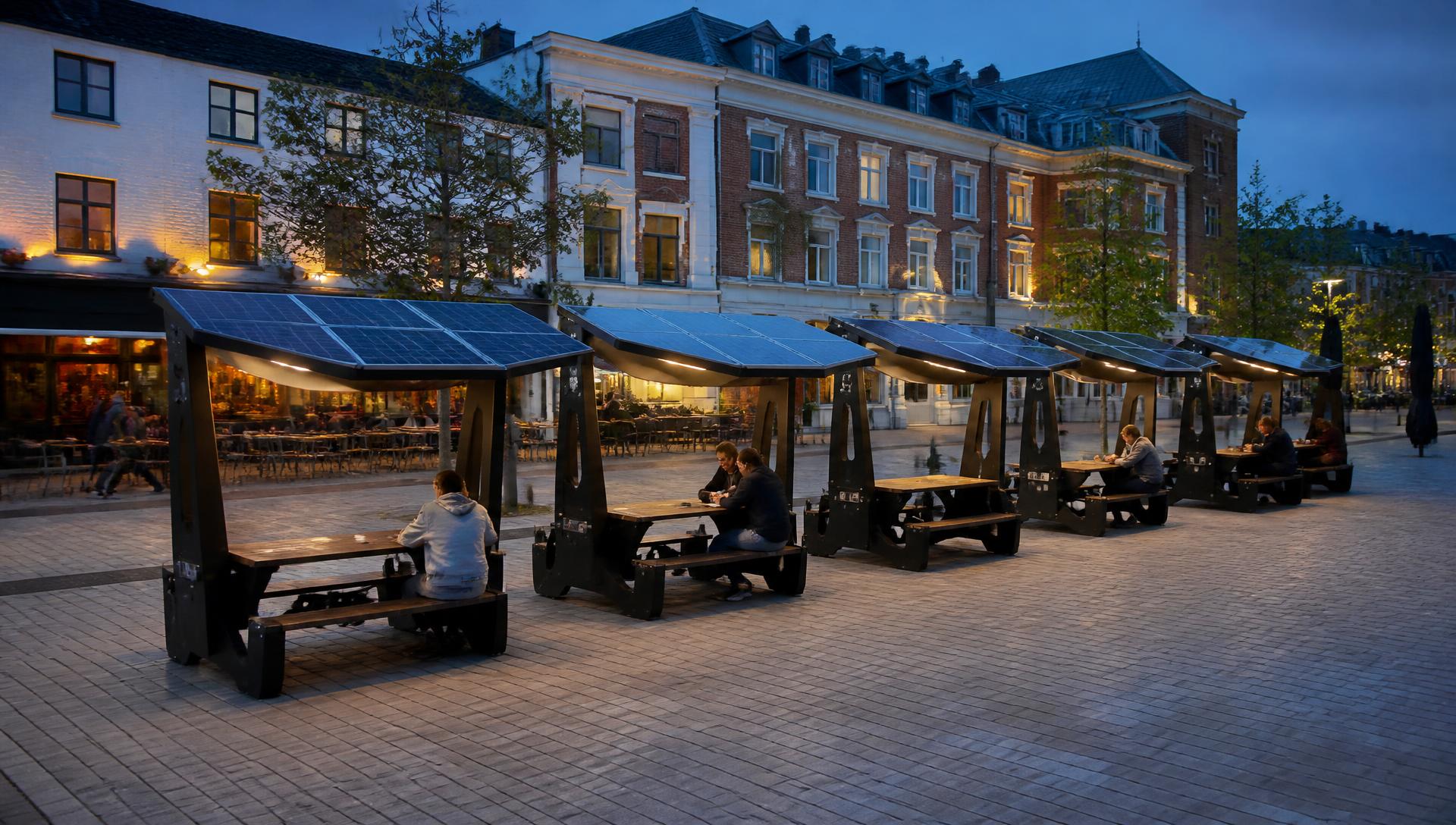
We turn things people throw away into smart outdoor furniture people use every day.
A solar module taken off a British roof cannot go back onto one, even at 99% of its output. Seven million Christmas trees are thrown away every January. Plastic waste sits in countries with no local buyer for it. We take all three and engineer them into a bench that gives its power away: free device charging, light after dark and a mesh node, on any patch of ground, with no trenching, no mains and no electrician. Which is also why one can stand at the top of a mountain.
0
Second-life modules per flagship canopy, a house-sized array across five benches
Verified0 kg
Plastic diverted into the structure of a single bench
Estimated0
Christmas trees machined into the slats of one bench
Estimated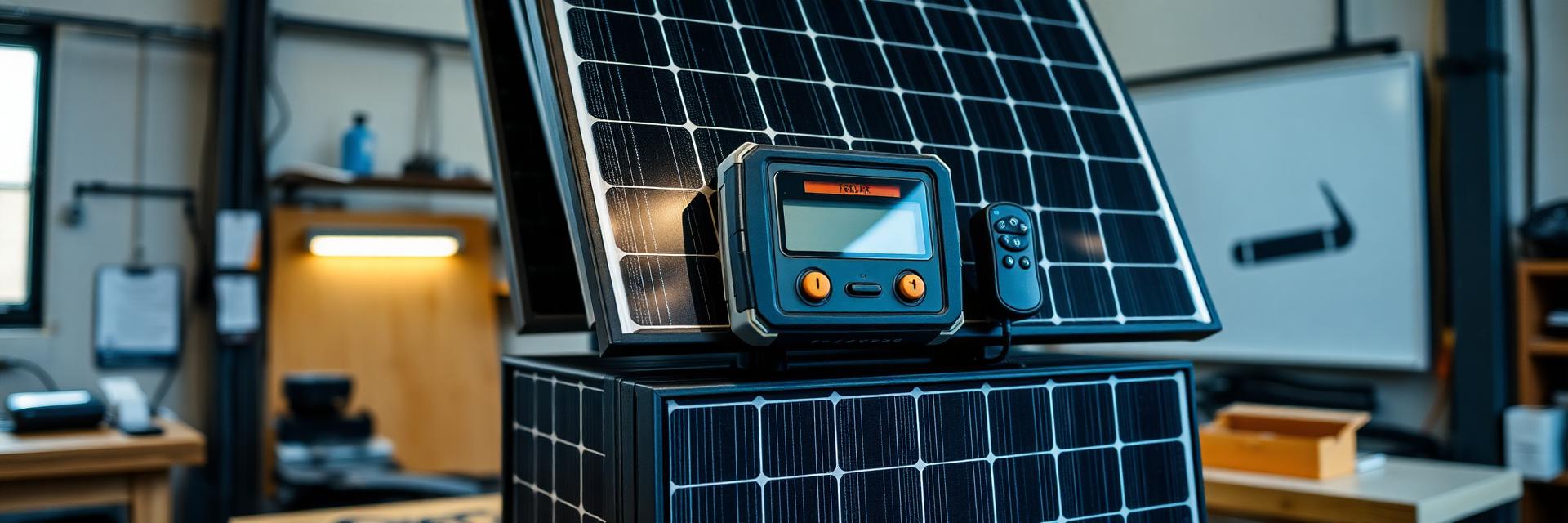
The panel is not worn out. It is disqualified.
Under MCS, certification travels with the product chain, not with the performance. Once a module is unbolted from a roof it leaves that chain and there is no route back in, so a panel measuring 92% of nameplate on a flash test is legally unfit for a certified roof install and commercially destined for a shredder.
Our canopy is off-grid, exports nothing and is not part of a building, so it sits outside that regime entirely. The same module gets another working decade. And because its holder is currently paying for collection and WEEE treatment, we buy at scrap-adjacent prices, the most expensive component in the bill of materials becomes the cheapest.

Not reclaimed timber. An engineered material compounded from waste.
The centre pole of a discarded Christmas tree is straight, dense pine. We machine it, press it and laminate it into seat and table slats, a slat stock with a known section and a known moisture content, not a pallet of salvage of unknown provenance.
The residue goes further. Pine fibre and hemp stalk from grower partners are digested, washed, dried and milled into cellulose powder, then compounded with recycled plastic into pellets and injection moulded into the bench sides and structure. It never rots, never needs painting and never gets hot to the touch in full sun.
Growers do not sell us that biomass. They pay us a quarter of what disposal costs them, so they keep three quarters of a bill they cannot avoid, our feedstock arrives with a credit attached, and 10% of profit is audited back into housing and social care in their districts.
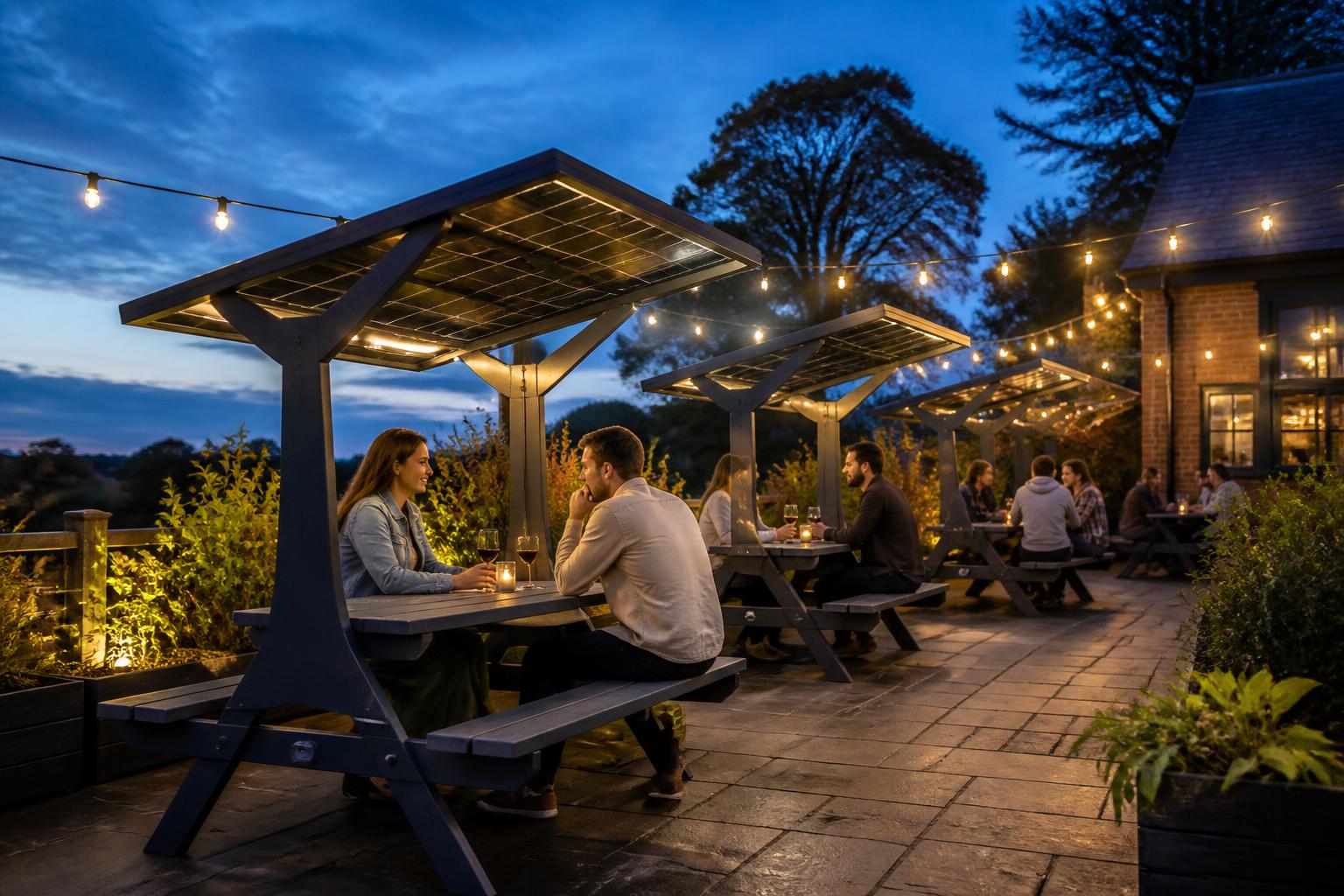
Four USB-C ports, dusk-to-dawn light and a mesh node. No groundworks.
One rigid module is about 405 W. The flagship canopy carries two, 810 W peak and roughly 640 kWh a year in the southern UK.
Five flagship benches carry ten reclaimed modules, about 4.05 kWp, the same panel count as a typical domestic rooftop system. A pub garden with five benches has put a house-sized solar array to work on land it was already using, and gained trading hours after dark.
It arrives on a pallet and is placed with a pallet truck. Nothing is trenched, nothing is wired into a distribution board, and it can be moved to wherever the footfall is.
The charge is free because there is nothing to bill for.
Public charging points normally carry a card reader because someone has to recover a supply connection, a meter and a standing charge. A Canopei canopy has none of those. The sun paid for the energy, the bench stores it, and the marginal cost of handing a person a phone charge is zero. So it is simply given away: USB-C ports and a wireless pad, no app, no account, no tariff, for as long as the bench is there.
That same absence of a cable is what makes the next part possible. If a bench needs nothing from the grid, it can be placed where the grid will never go: a trailhead, a coastal path, a summit cairn. There it stops being furniture and becomes a safety point, a lit marker with a socket for a head torch, a GPS unit or a satellite messenger, and a mesh node that can carry a short message out of a valley with no signal.
Everyday charging
Squares, campuses, parks and terraces. Four USB-C outputs and a wireless pad, sized so a midwinter day still serves a queue of handsets rather than only a summer one.
EstimatedTrail and summit beacons
A 0.6 W marker light through the dark hours, a protected reserve so it never goes out, and public charging as the only load that flexes when the light is poor.
EstimatedA message out of nowhere
Every unit is an rnode on the EN/ABEL Communications Enigma Mesh, so remote benches extend off-grid messaging along a route and give rescue teams a forward point to charge radios without a generator.
AssumedGive scrapped solar a second decade. Build the furniture out of waste streams that carry a disposal liability. Put power and connectivity where people already sit, and pay the districts that supply us.
Second-life solar
Ordinary rigid, framed mono-crystalline modules, the ones that come off domestic roofs during re-roofing and repowering, graded, flash tested, imaged and mounted as the canopy. Not flexible film. Not bespoke glass. The ordinary module, reused.
A material system
Machined Christmas tree timber for the slats, pine and hemp cellulose compounded with recycled plastic for the moulded structure. A soft-radius matte anthracite profile that looks expensive rather than worthy.
Power and coverage
Two USB-C PD ports at each end, dusk-to-dawn LED lighting under the canopy and an EN/ABEL Communications Enigma Mesh rnode with its own antenna in the upright, so every install adds mesh density as well as serving the site that bought it.
Made in Greater Manchester
Assembly, PV grading, electronics and compounding stay in the city region, the jobs, the rates and the wage spend land where the company is from.
The first city to industrialise is the right city to industrialise the way back.
Cottonopolis built the template for making things at scale. The Rochdale Pioneers wrote the co-operative rules that our 10% district pledge and 50/50 supplier SPVs still follow. Manchester opened Britain's first free public library on the argument that a public good costs less than its absence, which is exactly why this bench gives its charge away. Graphene came out of the same city in 2004, which is why an engineered cellulose composite can be compounded and commercialised here rather than described in a brochure.
The politics has caught up with it. A combined authority that franchised its buses and put one Bee Network identity across ten boroughs can specify lit, powered public seating once and roll it out city-region wide. And with business rates for pubs, social clubs and live music venues cut by 20% from April on top of January's 15%, the high street is being handed lower fixed costs. We add the other half: more hours it can trade in, outside, after dark, with nothing trenched and nothing metered.
Three live models you can move with your own numbers.
Manufacturing impact
A Manchester line with a live jobs, PAYE, National Insurance, business rates and UK GVA model you can move by output volume, laddered through an EU secondary phase to global licensing.
Open the calculatorCircular materials tracker
Trees converted versus wasted, biomass collected for a fee rather than bought, and the net feedstock cost per bench once those fees are netted off conversion.
Open the trackerPartnerships and the 10% pledge
50/50 SPVs with farmer bodies across ten candidate countries, the six-step cellulose process done in-country, and an audited allocation of 10% of profit to housing and social care in the districts that supply us.
Open partnershipsWhy the UK throws away solar panels that still work, and why a moveable bench is allowed to catch them.
Where the company is today.
Every figure on this platform is tagged Verified, Estimated or Assumed with its basis shown, and every financial output is computed from the assumptions register rather than stored as a constant.
Impact and ESG position.
The furniture is the product. The network is the compounding asset.
Each install carries its own generation, storage, local consumption and surplus reporting, and joins the EN/ABEL Communications Enigma Mesh as an active rnode. Coverage and mesh density grow with every adopted pub, hotel, restaurant, campus, holiday park and square, including the shadowed streets where conventional signal fails.